
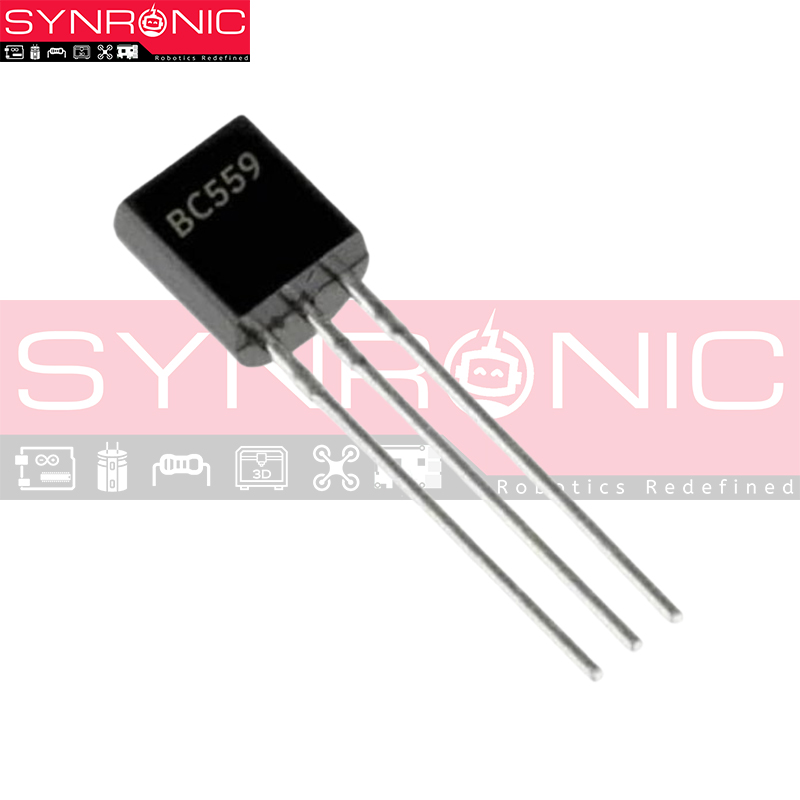
BC559 Transistor Bipolar-PNP (Pack of 5 Pieces)
The BC559 transistor is a general-purpose PNP bipolar junction transistor (BJT) used in various electronic circuits for low-power and low-noise applications. Here’s a brief overview:
Key Features:
Type: PNP Bipolar Junction Transistor (BJT)
Maximum Voltage Ratings:
Collector-Emitter Voltage (Vce): 30V
Collector-Base Voltage (Vcbo): 30V
Emitter-Base Voltage (Vebo): 5V
Collector Current (Ic): 100mA
Current Gain (hFE): 110 to 800
Power Dissipation (Ptot): 500mW
Package: TO-92
Applications:
Amplifiers: Used in audio and signal amplification circuits.
Switching: Suitable for low-power switching applications.
Signal Processing: Employed in various signal processing tasks.
The BC559 transistor is valued for its versatility and reliability in various electronic applications.
₹20.00 exc. GST
The BC559 Transistor is a versatile PNP bipolar junction transistor (BJT) that is commonly used in low-power, low-noise applications. Here’s a comprehensive overview of its features, working principles, and typical uses:
Overview
The BC559 transistor is designed for general-purpose applications in audio amplification and switching. Its low noise performance makes it particularly suitable for high-fidelity audio signal processing. It is housed in the compact TO-92 package, which is ideal for through-hole and breadboard applications.
Key Features:
Type: PNP Bipolar Junction Transistor
Maximum Voltage Ratings:
Collector-Emitter Voltage (Vce): 30V
Collector-Base Voltage (Vcbo): 30V
Emitter-Base Voltage (Vebo): 5V
Maximum Collector Current (Ic): 100mA
Power Dissipation (Ptot): 500mW
Current Gain (hFE): 110 to 800, ensuring good amplification capabilities
Low Noise Figure: Suitable for audio and low-level signal amplification
Package: TO-92
Pin Configuration:
The BC559 transistor has three pins:
Collector (C): Connected to the load.
Base (B): Controls the transistor; a small current here controls a larger current between the emitter and collector.
Emitter (E): Connected to the power supply.
Working Principle:
The BC559 operates in three distinct regions based on the base current:
Cutoff Region: Both the collector and emitter currents are zero because the base-emitter junction is not forward biased. The transistor behaves like an open switch.
Active Region: The transistor operates as an amplifier. A small current applied to the base controls a much larger current flowing from emitter to collector.
Saturation Region: The transistor acts as a closed switch with maximum current flow from emitter to collector, as the base-emitter junction is fully forward biased.
Applications:
Audio Amplifiers: Used in various amplifier configurations, including common emitter, common collector, and common base amplifiers. Particularly suitable for audio signal amplification due to its low noise.
Switching Applications: Acts as a switch in digital and analog circuits, turning on or off larger currents using a small base current.
Signal Processing: Suitable for low-level signal amplification and processing.
Oscillators: Used in oscillator circuits to generate periodic signals.
General Purpose: Utilized in various low-power and low-noise applications.
Advantages:
High Current Gain: The high hFE range allows significant amplification with low base current.
Low Noise: Provides clean amplification of audio signals, making it ideal for audio applications.
Versatility: Can be used in a wide range of applications, from switching to signal processing.
Compact Size: The TO-92 package is small and easy to handle in various circuit designs.
Affordable and Widely Available: Cost-effective and easy to find in most electronic component stores.
Implementation Tips:
Proper Biasing: Ensure proper biasing of the base-emitter junction to operate the transistor in the desired region (cutoff, active, or saturation).
Heat Management: Though it has a low power dissipation, consider heat management in high-current applications.
Correct Pin Identification: Double-check the pin configuration to avoid incorrect connections, which could damage the transistor.
Coupling Capacitors: In amplifier circuits, use coupling capacitors to block DC components and pass only the AC signal.
The BC559 transistor is a reliable and versatile component in electronics, valued for its excellent performance in low-power and low-noise applications. Whether you’re building amplifiers, switches, or signal processing circuits, the BC559 provides a dependable solution for your needs.
Based on 0 reviews
Be the first to review “BC559 Transistor Bipolar-PNP (Pack of 5 Pieces)”
Related products
-
Electronic Components
Diode 1n4007 (Pack of 5pcs)
The 1N4007 is a general-purpose rectifier diode in a DO-41 package. It is widely used in power supply circuits for converting AC to DC. Here’s a brief overview:
Key Features
Maximum Reverse Voltage: 1000VAverage Forward Current: 1A
Peak Forward Current: 30A
Power Dissipation: 3W
Low Reverse Current: 5µA
Operating Temperature: -55°C to +175°C
Pin Configuration
The 1N4007 diode has two main terminals:Anode: Current enters through this terminal.
Cathode: Current exits through this terminal (usually marked with a grey band).
Applications
Rectification: Converting AC to DC in power supplies.Voltage Protection: Blocking voltage spikes.
Battery Chargers: Preventing reverse polarity.
General Purpose: Any application requiring a diode for current flow regulation.
SKU: n/a -
Electronic Components
BC558 Transistor Bipolar-PNP (Pack of 5 Pieces)
The BC558 transistor is a PNP bipolar junction transistor (BJT) used for general-purpose low-power amplification and switching.
Key Features:
Type: PNP BJTMaximum Voltage: 30V (Vce)
Collector Current (Ic): 100mA
Current Gain (hFE): 110 to 800
Package: TO-92
Applications:
Amplifiers: Used in audio and signal amplification circuits.Switching: Suitable for low-power switching applications.
Signal Processing
SKU: n/a -
Electronic Components
BC549 Transistor Biploar-NPN (Pack of 5 Pieces)
The BC549 transistor is a general-purpose NPN bipolar junction transistor (BJT) used in a variety of electronic circuits. Here’s a brief overview:
Key Features:
Type: NPN Bipolar Junction Transistor (BJT)Maximum Collector-Emitter Voltage (Vce): 30V
Collector Current (Ic): 100mA
Current Gain (hFE): 110 to 800
Package: TO-92
Applications:
Amplifiers: Used in small-signal amplification circuits.Switching: Suitable for switching small loads.
Audio Processing: Employed in audio preamplification and noise filtering.
The BC549 transistor is valued for its versatility and reliability in various electronic applications.
SKU: n/a -
Electronic Components
L293d Motor Driver IC
The L293D is a popular 16-pin Dual H-Bridge motor driver IC used to control the direction and speed of DC motors.
Here are the key features:Bidirectional Control: Can drive two DC motors independently in both directions.
Current Handling: Provides up to 600 mA of continuous current per channel, with a peak current of 1.2A for short durations.
Voltage Range: Operates within a voltage range of 4.5V to 36V.
Enable Pins: Allows turning each motor on or off without altering the control logic.
Thermal Shutdown Protection: Protects against overheating.
Diode Protection: Internal flyback diodes prevent damage from back-EMF generated by the motors.
It’s commonly used in robotics, motor control applications, and DIY projects.
SKU: n/a


There are no reviews yet.