

SW420 Vibration Sensor Module
Out of stock
The SW-420 Vibration Sensor Module is a cost-effective and easy-to-use sensor for detecting vibrations. Here are some key features:
Key Features
Operating Voltage: 3.3V to 5V
Output: Digital output (Logic High or Low)
Sensitivity: Adjustable using an onboard potentiometer
Components: SW-420 vibration sensor, LM393 comparator, 10K potentiometer, LEDs
Applications: Anti-theft alarms, earthquake alarms, smart car systems, DIY projects
Applications
Home Security: Detects vibrations to trigger alarms.
Industrial Monitoring: Monitors machinery for unusual vibrations.
Automotive: Detects impacts or movements in vehicles.
DIY Projects: Ideal for hobbyists and educational projects
₹40.00 exc. GST
Out of stock
The SW-420 Vibration Sensor Module is a cost-effective and versatile sensor for detecting vibrations and shocks. Here’s a detailed overview:
Key Features
Operating Voltage: 3.3V to 5V, making it compatible with most microcontroller platforms.
Output: Digital output (High or Low), indicating the presence or absence of vibration.
Sensitivity: Adjustable via an onboard potentiometer to set the desired level of vibration required to trigger the output.
Components:
SW-420 Vibration Sensor: A spring-based sensor that detects vibrations and shocks.
LM393 Comparator: Compares the sensor output to a threshold set by the potentiometer.
10K Potentiometer: Used to adjust the sensitivity.
Indicator LEDs: Power LED and output LED to indicate the sensor status.
Dimensions: Compact size, typically around 32mm x 14mm x 12mm, making it easy to integrate into various projects.
Connection Pins: Three pins (VCC, GND, and D0) for easy interfacing with microcontrollers.
Specifications
Operating Voltage 3.3V to 5V
Current Consumption 15mA
Output Type Digital (High/Low)
Sensitivity Adjustment 10K Potentiometer
Dimensions 32mm x 14mm x 12mm
Connection Pins VCC, GND, D0
Applications
Home Security Systems:
Detects vibrations on doors, windows, and other entry points.
Triggers alarms or notifications when unusual vibrations are detected, enhancing security.
Industrial Monitoring:
Monitors machinery for unusual vibrations that may indicate malfunction or maintenance needs.
Helps in predictive maintenance by detecting early signs of mechanical issues.
Automotive Applications:
Detects impacts or movements in vehicles.
Useful for anti-theft systems and impact detection in smart cars.
Earthquake Detection:
Can be used to build simple earthquake detection systems.
Detects seismic vibrations and triggers alarms or safety protocols.
DIY and Educational Projects:
Ideal for hobbyists and students building custom projects.
Can be used with Arduino, Raspberry Pi, and other microcontrollers for various applications.
Setup and Usage
Connecting the Sensor:
Connect the VCC pin to the 3.3V or 5V supply from the microcontroller.
Connect the GND pin to the ground.
Connect the D0 (digital output) pin to a digital input pin on the microcontroller.
Adjusting Sensitivity:
Use the onboard potentiometer to adjust the sensitivity.
Rotate the potentiometer clockwise to increase sensitivity and counterclockwise to decrease it.
Programming:
Write a simple program to read the digital output from the sensor.
Configure the microcontroller to trigger an action (e.g., sound an alarm, send a notification) when a vibration is detected.
The SW-420 Vibration Sensor Module is a versatile and reliable sensor that can be used in various applications ranging from security systems to industrial monitoring and DIY projects. Its adjustable sensitivity and easy integration make it a valuable component for detecting vibrations and ensuring the safety and functionality of different systems.
Based on 0 reviews
Be the first to review “SW420 Vibration Sensor Module”
Related products
-
Sensor Boards And Modules
MQ 7 Gas Sensor Module
This gas sensor module MQ-7 is a gas sensor module specifically designed to detect levels of carbon monoxide (CO) gas in the environment. The gas sensor module MQ-7 is widely used in various applications such as gas leakage detection, industrial safety systems, and environmental monitoring.
SKU: n/a -
Sensor Boards And Modules
Current Sensor ACS712-20A
The ACS712-20A is another variant of the ACS712 current sensor series. Similar to the ACS712-5A, the ACS712-20A is an integrated circuit (IC) module designed for measuring current in electronic circuits using the Hall effect principle. However, the ACS712-20A has a higher nominal current rating of 20A, making it suitable for measuring higher current levels.
This module provides an analog voltage output that is proportional to the current passing through it. The output voltage has a sensitivity of 100mV per ampere of current, meaning that for every ampere of current flowing through the module, the output voltage will increase by 100mV.
SKU: n/a -
Sensor Boards And Modules
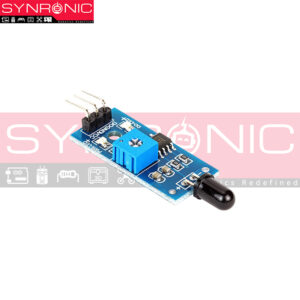
Flame Sensor Module
Infrared fire detection sensor designed for Arduino, Raspberry Pi, and robotics projects. With high sensitivity, fast response, and 0–5V output, it reliably detects flame presence for safety alarms, fire‑fighting robots, and automation systems. Compact and easy to integrate, this module is ideal for DIY electronics, smart security setups, and educational kits. Perfect for students, hobbyists, and professionals building fire detection, safety monitoring, or intelligent robotics applications
SKU: n/a -
Sensor Boards And Modules
MQ 3 Gas Sensor Module
MQ 3 Gas Sensor Module – Reliable Alcohol Detection! The MQ 3 gas sensor module is designed to detect alcohol vapors in the air. It operates at 5V DC and provides both analog and digital outputs. With a detection range of 25 to 500 ppm, it’s perfect for breathalyzers, safety systems, and environmental monitoring.SKU: n/a



There are no reviews yet.