


BC547 Transistor Bipolar-NPN (Pack of 5 Pieces)
The BC547 transistor is a general-purpose NPN bipolar junction transistor (BJT) commonly used in electronic circuits for low to medium current and low power applications. Here’s a brief overview:
Key Features:
Type: NPN Bipolar Junction Transistor (BJT)
Pin Configuration:
Collector (C): Pin 1
Base (B): Pin 2
Emitter (E): Pin 3
Current Gain (hFE): 110 to 800
Collector Current (Ic): 100mA
Emitter-Base Voltage (VBE): 6V
Base Current (IB): 5mA
Package: TO-92
Applications:
Switching: Used as a switch in various circuits.
Amplification: Commonly used in amplifier circuits.
Signal Processing: Employed in signal processing applications.
Working Principle:
The BC547 transistor works by controlling a large current between the collector and emitter terminals with a small current at the base terminal. When a small current is applied to the base, it allows a larger current to flow from the collector to the emitter, acting as an amplifier or switch
₹20.00 exc. GST
The BC547 Transistor is a highly versatile NPN bipolar junction transistor (BJT) that is widely used in various electronic circuits for amplification and switching. It is favored for its reliability and ease of use. Here’s an in-depth look at its features, working principles, and applications:
Overview:
The BC547 Transistor is a low-power transistor that can handle moderate current and voltage. It is packaged in a small TO-92 case, making it suitable for through-hole and breadboard prototyping.
Key Features:
Type: NPN Bipolar Junction Transistor
Maximum Collector-Emitter Voltage (Vceo): 45V
Maximum Collector-Base Voltage (Vcbo): 50V
Maximum Emitter-Base Voltage (Vebo): 6V
Maximum Collector Current (Ic): 100mA
Maximum Power Dissipation (Ptot): 500mW
DC Current Gain (hFE): 110 to 800 (varies by model – BC547A, BC547B, BC547C)
Noise Figure: Typically low, making it suitable for audio applications
Package: TO-92
Pin Configuration:
The BC547 transistor has three pins:
Collector (C): Connected to the load.
Base (B): Controls the transistor; small current here controls larger current between the collector and emitter.
Emitter (E): Connected to ground or the common terminal in circuits.
Working Principle:
The BC547 transistor operates in three different regions based on the applied base current:
Cutoff Region: D275Both the collector and emitter currents are zero because the base-emitter junction is not forward biased. The transistor behaves like an open switch.
Active Region: The transistor operates as an amplifier. A small current applied to the base controls a much larger current flowing from collector to emitter.
Saturation Region: The transistor acts as a closed switch with maximum current flow from collector to emitter, as the base-emitter junction is fully forward biased.
Applications:
Amplifier Circuits: The BC547 is used in various amplifier configurations, including common emitter, common collector, and common base amplifiers.
Switching Applications: Acts as a switch in digital and analog circuits, turning on or off larger currents using a small base current.
Signal Processing: Suitable for audio signal amplification and processing due to its low noise characteristics.
Oscillators: Used in oscillator circuits to generate periodic signals.
Current Sources and Sinks: Employed in current regulation circuits.
Advantages:
High Current Gain: The high hFE range allows significant amplification with low base current.
Versatility: Can be used in a wide range of applications, from switching to signal processing.
Low Noise: Provides clean amplification of audio signals.
Compact Size: The TO-92 package is small and easy to handle in various circuit designs.
Affordable and Widely Available: Cost-effective and easy to find in most electronic component stores.
Implementation Tips:
Proper Biasing: Ensure proper biasing of the base-emitter junction to operate the transistor in the desired region (cutoff, active, or saturation).
Heat Management: Though it has a low power dissipation, consider heat management in high-current applications.
Correct Pin Identification: Double-check the pin configuration to avoid incorrect connections, which could damage the transistor.
Coupling Capacitors: In amplifier circuits, use coupling capacitors to block DC components and pass only the AC signal.
The BC547 transistor is a cornerstone component in electronics, valued for its versatility, reliability, and ease of use. Whether you are building amplifiers, switches, or signal processing circuits, the BC547 provides a dependable solution for your needs.
Based on 0 reviews
Be the first to review “BC547 Transistor Bipolar-NPN (Pack of 5 Pieces)”
Related products
-
Electronic Components
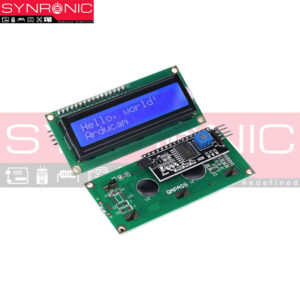
LCD 16×2 with I2C
The 16×2 LCD with I2C Module simplifies display in projects. Here are its key features:
Display Size: 16 columns, 2 rows
I2C Interface: Reduces wiring, uses only two data pins
Power Supply: 5V operation
Backlight: Enhanced visibility
Compatibility: Works with Arduino, Raspberry Pi, etc.
Ideal for displaying sensor data, creating user interfaces, and educational projects.
SKU: n/a -
Electronic Components
2n2222A Transistor Bipolar-NPN (Pack of 5 Pieces)
The 2N2222A transistor is a general-purpose NPN bipolar junction transistor (BJT) commonly used for low to medium current and voltage applications.
Key Features:
Type: NPN BJTMaximum Voltage:
Collector-Emitter Voltage (Vce): 40V
Collector-Base Voltage (Vcbo): 75V
Emitter-Base Voltage (Vebo): 6V
Collector Current (Ic): 800mA
Power Dissipation (Ptot): 625mW
Current Gain (hFE): 35 to 300
Package: TO-92
Applications:
Amplifiers: Audio and signal amplification circuits.Switching: Low to medium power switching applications.
Signal Processing: Used in various signal processing tasks.
The 2N2222A transistor is valued for its versatility and reliability in various electronic applications.
SKU: n/a -
Electronic Components, Others
LCD 16×2 Display Yellow
The 16×2 LCD with a yellow backlight is a great choice for projects needing clear visibility.
Here are its key features:Display Size: 16 columns, 2 rows
Backlight: Yellow, enhancing readability
I2C Interface: Simplifies wiring and reduces pin usage
Power Supply: Operates at 5V
Contrast Adjustment: Typically includes a potentiometer for optimal readability
It’s perfect for Arduino-based projects and other microcontroller applications.
SKU: n/a -
Electronic Components
L293d Motor Driver IC
The L293D is a popular 16-pin Dual H-Bridge motor driver IC used to control the direction and speed of DC motors.
Here are the key features:Bidirectional Control: Can drive two DC motors independently in both directions.
Current Handling: Provides up to 600 mA of continuous current per channel, with a peak current of 1.2A for short durations.
Voltage Range: Operates within a voltage range of 4.5V to 36V.
Enable Pins: Allows turning each motor on or off without altering the control logic.
Thermal Shutdown Protection: Protects against overheating.
Diode Protection: Internal flyback diodes prevent damage from back-EMF generated by the motors.
It’s commonly used in robotics, motor control applications, and DIY projects.
SKU: n/a



There are no reviews yet.