
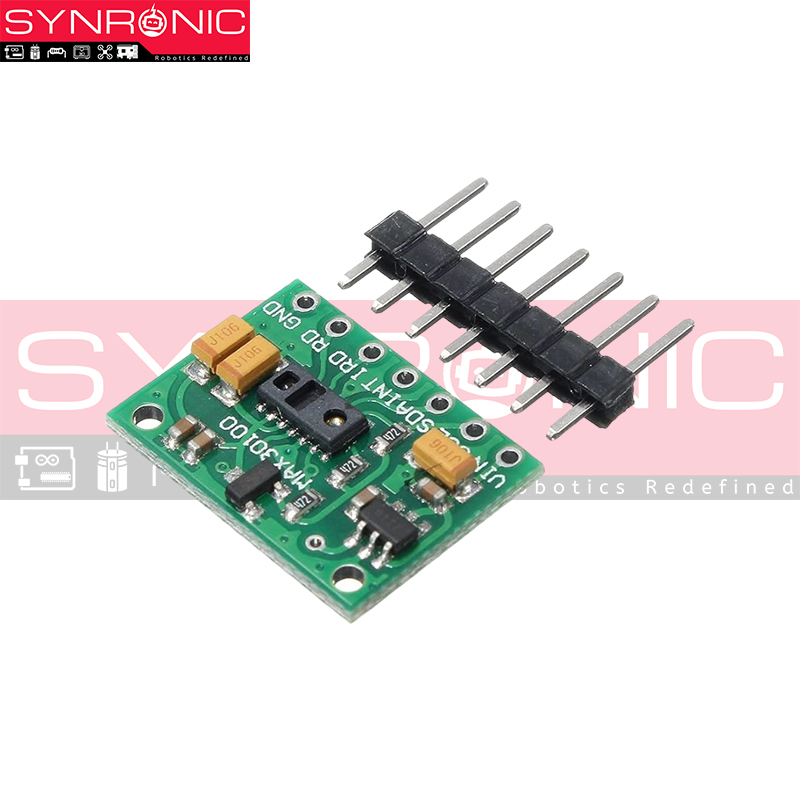
Max30100 Module-Pulse and Heart Rate
MAX30100 Module – Heart Rate and SpO2 Sensor!
Max30100 module measures heart rate and blood oxygen saturation (SpO2). It features low power consumption, an I2C interface, and an onboard temperature sensor. Ideal for medical devices, fitness trackers, and health monitoring systems.
₹85.00 exc. GST
Based on 0 reviews
Be the first to review “Max30100 Module-Pulse and Heart Rate”
Related products
-
Sensor Boards And Modules
Accelerometer ADXL345
The ADXL345 is a popular and widely used digital accelerometer. It is a small, low-power, three-axis accelerometer that measures acceleration forces in three dimensions (X, Y, and Z).
The ADXL345 sensor is commonly used in various applications such as robotics, gaming, motion detection, and tilt sensing. It provides high-resolution measurement capabilities and can measure accelerations in the range of ±2 g to ±16 g.
SKU: n/a -
Sensor Boards And Modules
IR Sensor Module
An IR sensor module(infrared sensor module) is a device that detects infrared radiation and is commonly used for proximity sensing, object detection, and motion detection.
IR sensor modules can operate in different sensing modes, including proximity sensing and motion detection. Proximity sensing detects the presence of an object within a specific range, while motion detection detects movement within the sensor’s field of view.SKU: n/a -
Sensor Boards And Modules
Current Sensor ACS712 30A
The ACS712-30A current sensor is a commonly used current sensor with a 30A nominal current rating. It is not a module itself but rather the maximum current rating of the ACS712 series that can be used to measure currents up to 30A.
To measure currents up to 30A, you can use the ACS712-30A IC in your circuit. It operates similarly to other ACS712 modules, employing the Hall effect to sense the magnetic field generated by the current flowing through a conductor and converting it into a voltage output. The output voltage will have a sensitivity of 66mV per ampere of current.
SKU: n/a -
Sensor Boards And Modules
Current Sensor ACS712-20A
The ACS712-20A is another variant of the ACS712 current sensor series. Similar to the ACS712-5A, the ACS712-20A is an integrated circuit (IC) module designed for measuring current in electronic circuits using the Hall effect principle. However, the ACS712-20A has a higher nominal current rating of 20A, making it suitable for measuring higher current levels.
This module provides an analog voltage output that is proportional to the current passing through it. The output voltage has a sensitivity of 100mV per ampere of current, meaning that for every ampere of current flowing through the module, the output voltage will increase by 100mV.
SKU: n/a


There are no reviews yet.