

Pulse Sensor Module
The Pulse Sensor Module is a compact, plug-and-play heart-rate sensor designed for easy integration with microcontrollers like Arduino. It uses a green LED to shine light into the skin and a photodetector to measure the amount of reflected light, which changes with blood flow. This allows it to detect heartbeats and output an analog signal representing the pulse rate1. Ideal for health monitoring, fitness trackers, and educational projects.
₹120.00 exc. GST
Based on 0 reviews
Be the first to review “Pulse Sensor Module”
Related products
-
Sensor Boards And Modules
MQ 7 Gas Sensor Module
This gas sensor module MQ-7 is a gas sensor module specifically designed to detect levels of carbon monoxide (CO) gas in the environment. The gas sensor module MQ-7 is widely used in various applications such as gas leakage detection, industrial safety systems, and environmental monitoring.
SKU: n/a -
Sensor Boards And Modules
Current Sensor ACS712-5A
The ACS712-5A is an integrated circuit (IC) module that is commonly used for measuring current in electronic circuits. It is a Hall effect-based linear current sensor that can accurately measure both AC and DC currents.
The ACS712-5A module has a 5A nominal current rating, meaning it is designed to measure currents up to 5A. It provides an analog output voltage that is proportional to the measured current, allowing easy interfacing with microcontrollers or other analog-to-digital converters (ADCs).
SKU: n/a -
Sensor Boards And Modules
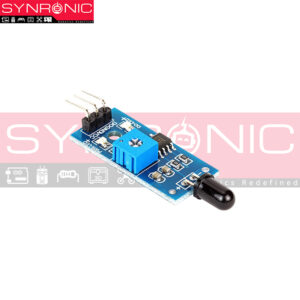
Flame Sensor Module
Infrared fire detection sensor designed for Arduino, Raspberry Pi, and robotics projects. With high sensitivity, fast response, and 0–5V output, it reliably detects flame presence for safety alarms, fire‑fighting robots, and automation systems. Compact and easy to integrate, this module is ideal for DIY electronics, smart security setups, and educational kits. Perfect for students, hobbyists, and professionals building fire detection, safety monitoring, or intelligent robotics applications
SKU: n/a -
Sensor Boards And Modules
Current Sensor ACS712-20A
The ACS712-20A is another variant of the ACS712 current sensor series. Similar to the ACS712-5A, the ACS712-20A is an integrated circuit (IC) module designed for measuring current in electronic circuits using the Hall effect principle. However, the ACS712-20A has a higher nominal current rating of 20A, making it suitable for measuring higher current levels.
This module provides an analog voltage output that is proportional to the current passing through it. The output voltage has a sensitivity of 100mV per ampere of current, meaning that for every ampere of current flowing through the module, the output voltage will increase by 100mV.
SKU: n/a


There are no reviews yet.