
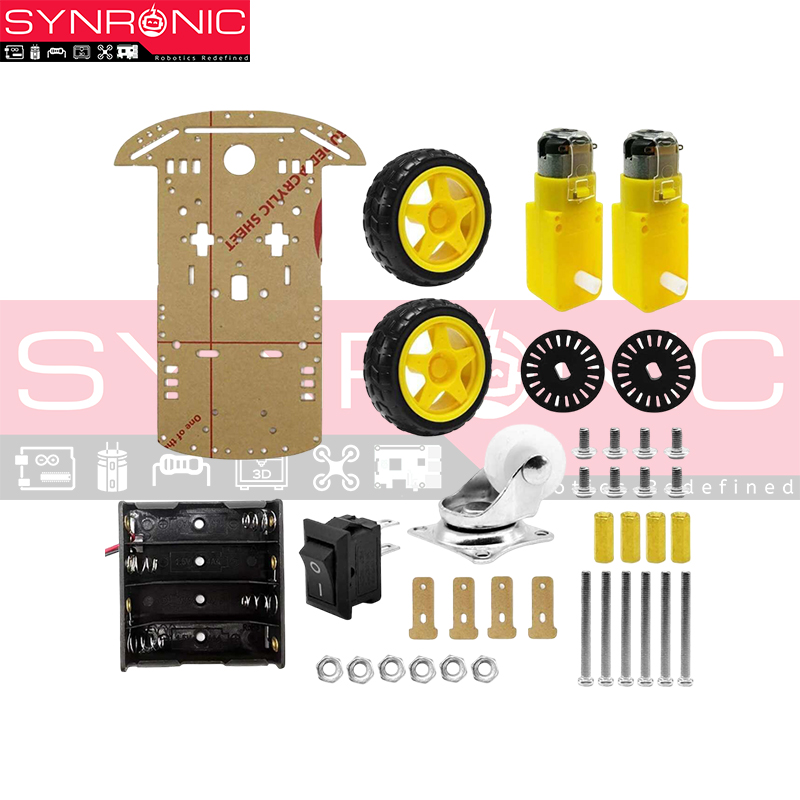
2WD Two Wheel Drive BO Motor DIY Kit Acrylic
The Two Wheel Drive (2WD) Robot Kit is a great DIY project for building a smart robot. Here are some key features:
Components
Chassis: Made from laser-cut acrylic, it’s sturdy and customizable.
BO Motors: Two gear motors (1:48 ratio) for driving the wheels.
Wheels: Two wheels and one supporting universal caster wheel.
Battery Compartment: Holds four AA batteries (not included).
Mounting Holes: Includes holes and openings for mounting sensors, servo motors, motor drivers, and control modules.
Applications
Distance Sensing: Can be used for distance measurement projects.
Obstacle Avoidance: Ideal for building robots that can detect and avoid obstacles.
Line Following: Suitable for line-following robots.
Wireless Control: Can be used to create a wireless remote-controlled car.
Creative Projects: Great for any other creative robotics projects you can think of.
Additional Features
Easy Assembly: The kit is designed for easy assembly and customization.
Versatility: Can be used with various sensors and control modules to expand its functionality
₹310.00 exc. GST
The Two Wheel Drive (2WD) Robot Kit with BO Motors is an excellent DIY project for anyone interested in robotics. This kit provides all the essential components to build a basic two-wheel drive robotic platform, suitable for a variety of applications from simple movement to advanced sensor integration. Here’s an in-depth look at what’s included and the potential uses:
Components
Chassis:
Material: Made from laser-cut acrylic or durable plastic, the chassis is sturdy and lightweight, providing a solid base for your robot.
Design: Pre-drilled mounting holes and slots for easy attachment of motors, sensors, control boards, and other components.
BO Motors:
Type: Two BO (Battery Operated) gear motors with a gear ratio of 1:48, offering a good balance of speed and torque.
Mounting Brackets: Comes with mounting brackets and screws to securely attach the motors to the chassis.
Wheels:
Type: Two rubber wheels that provide good traction and stability.
Size: Typically around 65mm in diameter, suitable for various terrains.
Caster Wheel:
Type: A universal caster wheel that acts as a support wheel, allowing the robot to pivot and turn smoothly.
Placement: Mounted at the front or rear of the chassis for balance.
Battery Compartment:
Type: Holds four AA batteries (not included), providing power to the motors and electronics.
Placement: Easily mounted on the chassis with screws or adhesive.
Other Components:
Mounting Hardware: Includes screws, nuts, and bolts required for assembly.
Wiring and Connectors: Wires and connectors to link the motors to the control board.
Applications
Basic Movement:
Remote Control: Control the robot wirelessly using a remote control system.
Autonomous Navigation: Program the robot to move autonomously, avoiding obstacles and navigating predefined paths.
Sensor Integration:
Line Following: Add line sensors to create a robot that can follow a path marked on the ground.
Obstacle Avoidance: Integrate ultrasonic or infrared sensors to enable the robot to detect and avoid obstacles.
Educational Projects:
STEM Learning: Great for teaching students about robotics, electronics, and programming.
DIY Hobby Projects: Perfect for hobbyists looking to build and customize their own robotic creations.
Advanced Robotics:
AI and Machine Learning: Integrate with advanced sensors and control systems to experiment with AI and machine learning applications in robotics.
Home Automation: Use the robot as a platform for home automation projects, such as automated vacuuming or surveillance.
Advantages
Versatility: The kit can be customized and expanded with additional sensors, control boards, and accessories to suit various applications.
Ease of Assembly: Designed for easy assembly with clear instructions, making it accessible to beginners and experienced builders alike.
Educational Value: Provides hands-on experience with robotics, encouraging learning and creativity.
Affordability: Offers a cost-effective way to get started with robotics, without the need for expensive equipment.
Assembly and Usage Tips
Step-by-Step Instructions: Follow the provided instructions carefully to ensure correct assembly. Many kits come with detailed manuals or online resources.
Testing and Calibration: Once assembled, test the robot’s movement and calibrate the sensors to ensure optimal performance.
Coding and Programming: Use microcontrollers like Arduino or Raspberry Pi to program the robot. There are many open-source libraries and tutorials available for various projects.
Safety Precautions: Handle the components carefully, especially when soldering or working with electrical connections. Always double-check connections to avoid short circuits.
Based on 0 reviews
Be the first to review “2WD Two Wheel Drive BO Motor DIY Kit Acrylic”
Related products
-
DIY Kits
DSO138 2.4 inch TFT Handheld Pocket-size Digital Oscilloscope Kit DIY
The DSO138 Digital Oscilloscope DIY Kit is a compact, pocket-sized oscilloscope that allows hobbyists and students to build their own oscilloscope from scratch. It features a 2.4-inch color TFT display, ARM Cortex-M3 processor (STM32F103C8), and supports real-time sampling rates up to 1Msps. This kit is perfect for learning about oscilloscope circuitry and gaining hands-on experience in electronics assembly and troubleshooting.
SKU: n/a -
DIY Kits
37 in 1 Sensor Kit for Arduino, Raspberry Pi And Nodemcu
The 37-in-1 Sensor Kit is a comprehensive collection of 37 different sensor modules designed for microcontroller projects. It includes a wide range of sensors such as temperature and humidity sensors, motion detectors, light sensors, and more. This kit is compatible with Arduino, Raspberry Pi, and other popular microcontrollers, making it perfect for DIY projects, robotics, and educational purposes
SKU: n/a -
DIY Kits
Robot Car Metal Chassis 4wheel
A four-wheel metal chassis with a caster wheel is a versatile design often used in robotics and engineering projects. This setup typically includes:
Four primary drive wheels: These wheels are usually powered by motors, allowing the chassis to move in multiple directions.
One caster wheel: Similar to the two-wheel chassis, this wheel provides additional stability and enables smooth directional changes without being powered.
This configuration can be ideal for larger, more stable robots or vehicles that require better balance and control.
SKU: n/a -
DIY Kits, Drone Spare Parts And Accessories
XYQ-2 Drone Quadcopter DIY Kit
The XYQ-2 DIY Drone Kit is a wooden assembly quadcopter kit designed for beginners and hobbyists interested in drone technology. It features:
– DIY Wooden Frame – Lightweight and durable laser-cut wooden parts for easy assembly.
– Quadcopter Design – Includes motors, propellers, flight controller, and battery for a functional drone.
– Remote Control Operation – Supports altitude hold, headless mode, one-key takeoff/landing, and 3D flips.
– Rechargeable Battery – Provides stable power for extended flight time.
– STEM Learning – Ideal for understanding aerodynamics, electronics, and mechanics.This kit is perfect for educational projects, home learning, and drone-building enthusiasts
SKU: n/a


There are no reviews yet.